
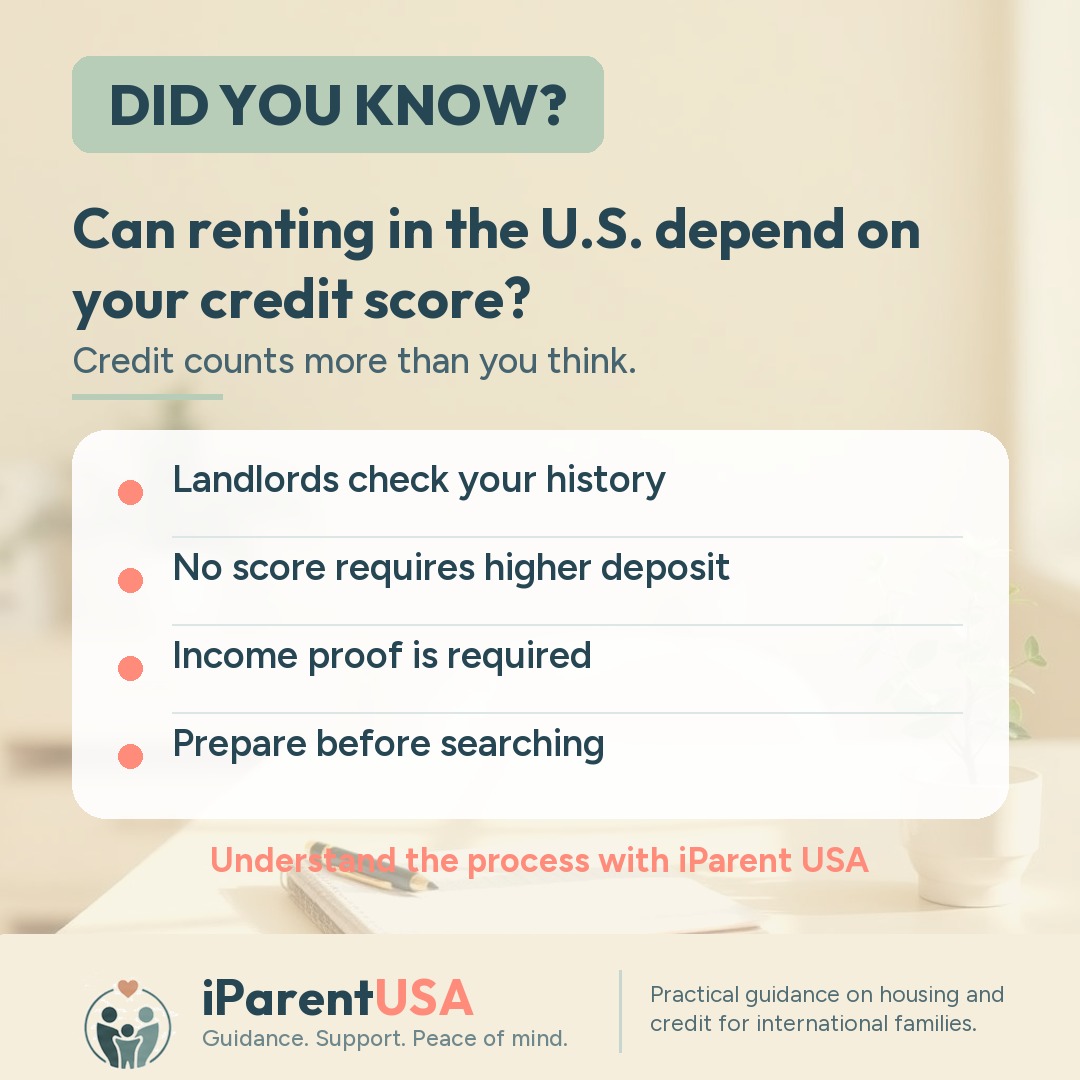
For people arriving in the U.S. without a local credit history, the search for a rental home can turn out more bureaucratic than expected. Many landlords and property managers use credit scores as one of the main approval criteria, which can surprise families who never had to prove 'financial reliability' quite this way before.
Why credit scores factor into rental decisions
Landlords and property managers use credit scores, along with income verification and references, to estimate the risk of late or missed rent payments. A low or nonexistent score doesn't automatically mean rejection, but it often leads to additional requests, such as a larger security deposit, a local co-signer, or proof of several months of rent paid in advance.
Requirements vary widely between states, cities, and even between property managers in the same city, so it's always worth asking directly what criteria a given landlord uses.
The specific challenge of having no U.S. history
It's common for recent immigrants to simply have no U.S. credit history at all, which is different from having a low score. In these cases, some property managers accept alternative documentation, such as international bank reference letters, proof of employment or a scholarship, bank statements, and proof of stable income.
Building local credit takes time, usually through a credit card, a bank account, and consistently paid bills, which is why many families start this process as soon as they arrive, even before they need to rent a new place.
Alternatives when your history is still short
Alternative screening services, co-signers, and larger deposits are commonly used paths. Some platforms also offer paid 'rental guarantee' services that function as a substitute for a traditional co-signer, for a fee.
Always read the lease carefully, and if you're unsure about the legal terms of the rental, seek guidance from a qualified local real estate professional.
What to check before renting
- Ask directly what credit and income criteria the landlord or property manager requires.
- Gather alternative documentation (bank references, proof of income) if you don't yet have local credit history.
- Consider opening a local bank account and credit card as soon as possible to start building history.
- Compare requirements across different property managers, since they vary widely.
- Read the lease carefully and clarify questions with a professional before signing.
Want to talk about your family's situation?
Book a free 15-minute consultation or get the free guide to your first 30 days in the United States.
Full guide on this topic: Real estate
Read next
- Does your U.S. credit score start from zero?Learn how the U.S. credit score system works and why newcomers start with no history at all. Practical, responsible steps to begin building credit.
- Pay cash or get a mortgage in the U.S.: which wins?Compare the trade-offs of paying cash versus getting a mortgage for a home in the United States, and see what to weigh before deciding.
- What Renter's Insurance can cover for tenants in the U.S.The landlord's policy usually doesn't cover your belongings. Learn what Renter's Insurance is, what it can cover, and when a landlord may require it in the lease.