
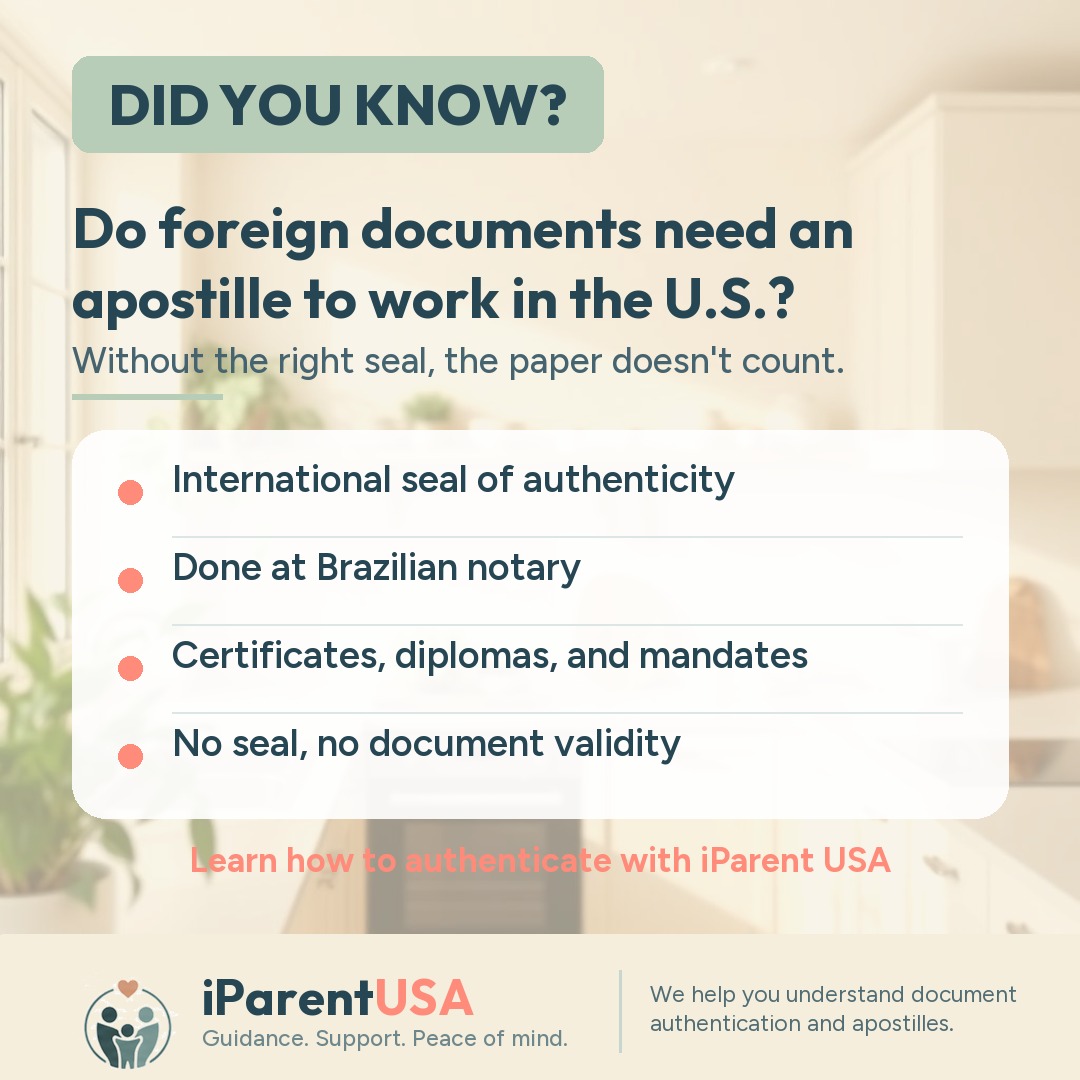
Birth certificates, marriage certificates, and diplomas issued abroad aren't always automatically accepted in the United States: in many situations, an apostille, an international authentication seal, is required for a U.S. institution to recognize the document as valid.
What an apostille is and what it's for
An apostille is a certificate confirming the authenticity of a public document issued in one country, allowing it to be recognized in another country that's part of the Hague Apostille Convention, which includes both the issuing country and the United States.
Without an apostille, a document can be rejected by schools, notaries, immigration authorities, or financial institutions in the U.S., even if it's perfectly valid at home, because the U.S. institution has no way to verify its authenticity on its own.
When an apostille is usually requested
Common situations include school enrollment, immigration processes, getting married in the U.S., diploma recognition for academic or professional purposes, and starting certain legal proceedings.
Each institution decides which documents it requires and whether it accepts apostilled copies or needs the original, so it's worth confirming the exact requirement before starting the apostille process, which can take time.
How the process generally works abroad
In most countries, an apostille is issued by an authorized government office, usually based on the original document or an updated certified copy. Some documents also need a certified translation into English, done separately from the apostille.
Since timelines and costs vary between offices and the process can take days or weeks, it's advisable to start the apostille process early and, in more specific cases, seek guidance from a professional specialized in international documentation.
Before apostilling your documents
- Confirm with the U.S. institution which documents need an apostille
- Check whether a certified translation is also required
- Find an authorized office to handle the apostille
- Plan ahead, since the process can take time
- Keep digital copies of all apostilled documents
Want to talk about your family's situation?
Book a free 15-minute consultation or get the free guide to your first 30 days in the United States.
Full guide on this topic: Everyday life
Read next
- Is your foreign driver's license valid in the U.S.?Whether a foreign driver's license is valid in the U.S. depends on the state. Learn when a local license is required and what documents are usually needed.
- Does your U.S. credit score start from zero?Learn how the U.S. credit score system works and why newcomers start with no history at all. Practical, responsible steps to begin building credit.
- Is the price on the tag not the final price?U.S. sales tax isn't included on the price tag and varies by state and city. Learn how this tax works and how to plan your purchases accordingly.