
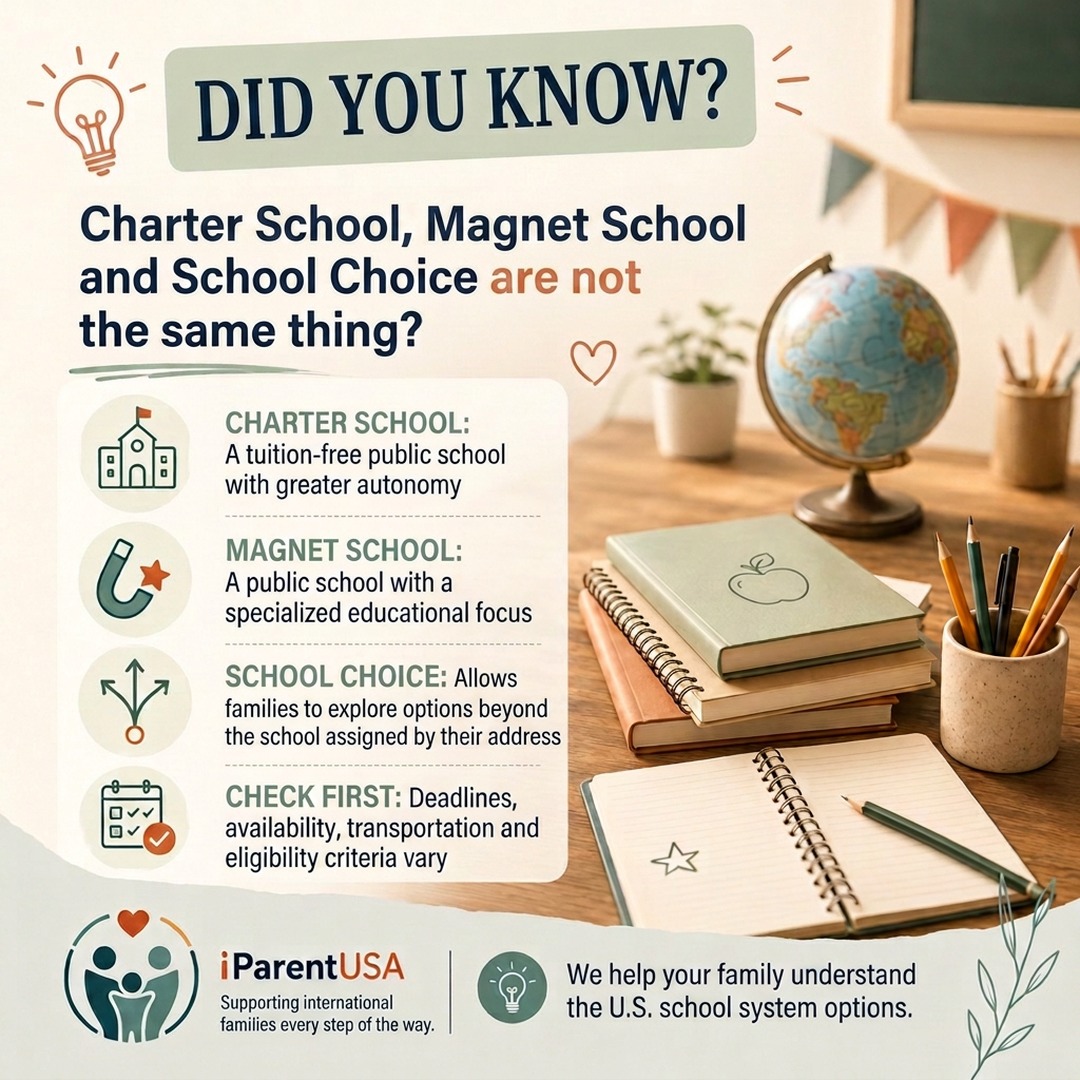
While researching school options in the United States, families often run into three similar-sounding terms that actually describe different systems: charter school, magnet school, and school choice. Each has its own enrollment rules, funding, and selection process.
Charter schools
Charter schools are publicly funded schools run independently of the traditional school district, usually by nonprofit organizations, under a contract ('charter') that sets out their curriculum and goals. They don't charge tuition and often have limited seats, filled through a lottery when demand outpaces availability.
Each charter school has its own enrollment calendar, and students who don't live in the zone of a traditional school can still apply, depending on state rules.
Magnet schools
Magnet schools are public schools run by the school district itself, but with a specialized focus, such as the arts, sciences, technology, or languages. They were historically created, among other goals, to promote diversity within districts by drawing families from different neighborhoods into a distinctive curriculum.
Enrollment in magnet schools usually involves an application, and some require a skills assessment, portfolio, or interview depending on the program's focus and the district.
School choice
School choice is a broader term describing policies that let families choose among different public school options beyond their zoned school — including charter schools, magnet schools, inter-district transfers, and, in some states, vouchers for private schools.
School choice rules vary widely from state to state and even district to district, so it's worth checking directly with the local school district which options exist and what the enrollment deadlines are.
What to check when considering these options
- Check the school district's website for which school choice options exist in your area.
- Verify enrollment deadlines, since many windows open months before the school year starts.
- Ask whether the school you're interested in uses a lottery, application, or assessment for admission.
- Consider transportation logistics, since charter and magnet schools don't always offer school buses.
- Compare curriculum and support offered to students who are still learning English.
Want to talk about your family's situation?
Book a free 15-minute consultation or get the free guide to your first 30 days in the United States.
Full guide on this topic: School system
Read next
- Can the right house change your child's school?Learn how your home address determines your child's assigned public school in the U.S., and what to verify before renting or buying in a new neighborhood.
- Can your child take advanced classes without changing schools?Learn how gifted and talented programs work in American public schools and how to request an evaluation for your child.
- Can your child get school support without being gifted?Understand the difference between an IEP and a 504 Plan, two formal paths for school support in the US for kids with specific learning or health needs.