
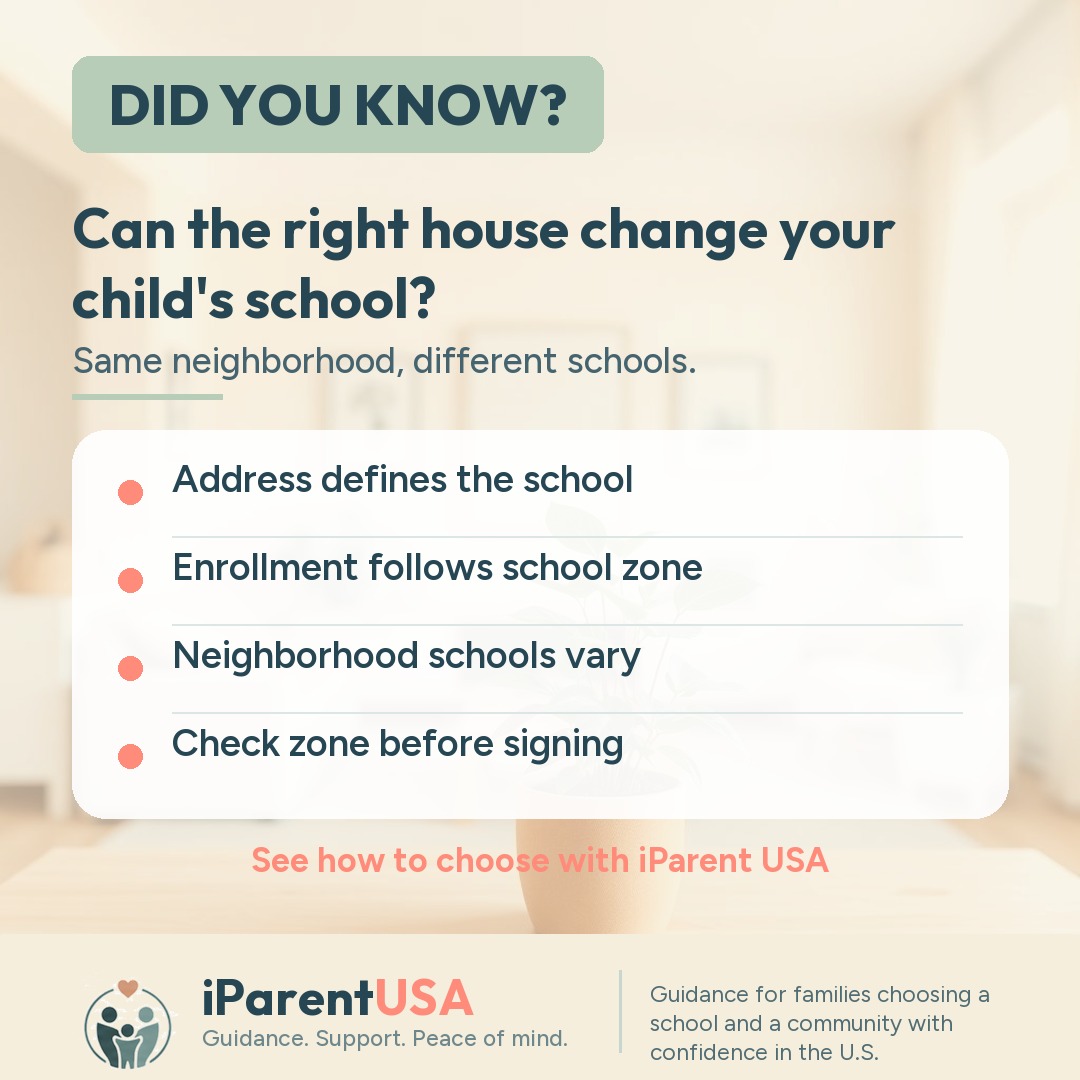
In the United States, the public school your child is assigned to is almost always tied to your home address, not just the city you live in. That means two houses on the same street can fall into different school zones, with very different schools.
What a school zone actually is
Each school district divides its territory into attendance zones for elementary, middle and high schools. The system uses a family's residential address to determine which public school a child is entitled to attend, generally at no tuition cost.
These boundaries can shift year to year as districts adjust for population growth or new construction, so choosing a home based only on a neighborhood's general reputation can miss what actually matters for enrollment.
How to check the assigned school before you move
Most school districts publish an online address-lookup tool (a school locator) on their official website. You can also call the district directly and ask which school serves a specific address before signing a lease or purchase agreement.
Always confirm with the school district itself rather than relying only on a real estate listing, since listings can show outdated or inaccurate school assignments.
What to weigh beyond school ratings
Public ratings and rankings are a useful starting point, but it's also worth checking specific programs offered, such as bilingual education, gifted programs, or English learner support (ESOL), which may matter more for a newly arrived family.
Visiting the school when possible, and asking the district about enrollment requirements and deadlines, helps avoid surprises right before the school year starts.
What to check before settling on an address
- Confirm the exact assigned school directly with the district's website or office
- Ask about any planned rezoning for upcoming school years
- Check for specific programs (ESOL, gifted, special education) at that school
- Request the enrollment document checklist in advance
- Don't rely solely on the school info shown in a property listing
Want to talk about your family's situation?
Book a free 15-minute consultation or get the free guide to your first 30 days in the United States.
Full guide on this topic: School system
Read next
- Can renting in the U.S. depend on your credit score?Learn how credit scores affect rental approval in the United States and what newly arrived families without a credit history can do about it.
- Pay cash or get a mortgage in the U.S.: which wins?Compare the trade-offs of paying cash versus getting a mortgage for a home in the United States, and see what to weigh before deciding.
- Does property tax change from city to city?Understand why property tax changes from city to city in the U.S. and what that means for a family's housing budget and where to live.
- Charter School, Magnet School, and School Choice are not the same thingUnderstand what sets Charter Schools, Magnet Schools, and School Choice apart in the U.S., who can apply, how deadlines work, and what to check before deciding.