
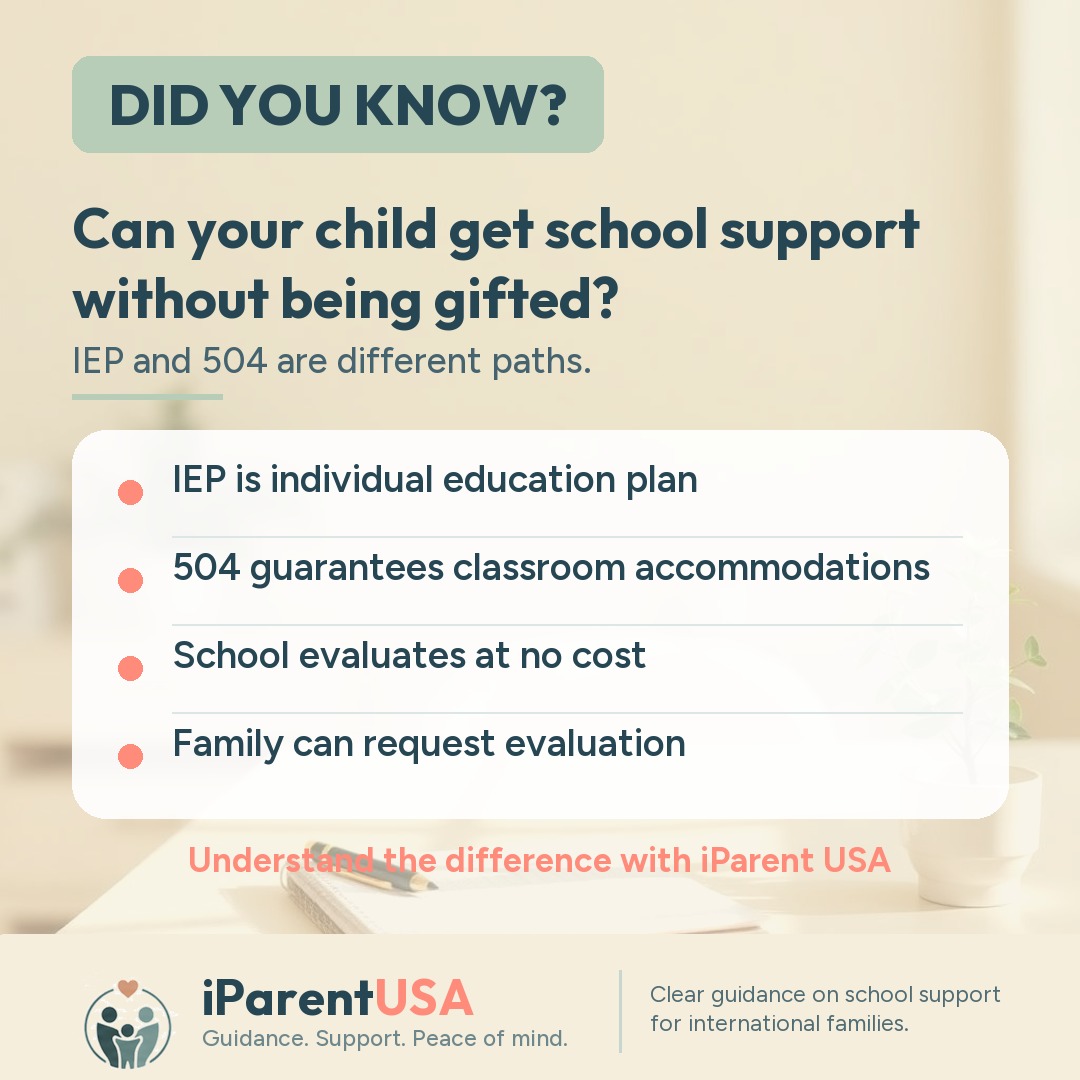
In the American school system, extra support isn't reserved only for students with serious challenges, nor is it exclusive to gifted programs. There are two well-established formal paths, the IEP and the 504 Plan, designed to adjust instruction to each child's specific needs.
What an IEP is
An IEP (Individualized Education Program) is a formal plan, required by federal law, created for students with a disability that directly affects educational performance, such as dyslexia, more severe ADHD, speech delays or autism spectrum conditions. It spells out specific goals, support services like speech therapy or occupational therapy at school, and how progress will be measured.
The evaluation process for an IEP usually involves psychoeducational testing done by the school district itself, meetings with parents and a periodic review of the plan. Criteria and timelines vary from district to district, so it's worth asking the school directly about the local process.
What a 504 Plan is
A 504 Plan is based on a different federal law and covers a broader range of conditions that affect learning, even without requiring special education services. It focuses on accommodations, such as extra time on tests, preferential seating, breaks during the day or adjustments for medical conditions like severe allergies and diabetes.
Unlike the IEP, a 504 does not necessarily include specialized instruction, but it removes barriers so the student has equal access to the regular curriculum.
How international families can start the process
If the teacher, pediatrician or parents themselves suspect a child would benefit from one of these plans, the first step is to request a formal evaluation in writing from the school. It's important to remember that rules, timelines and eligibility vary by state and school district, so this information is a starting point, not a guarantee of eligibility.
What to do if you suspect your child needs support
- Talk first with the classroom teacher about the behavior or performance you've noticed.
- Request a formal evaluation in writing through the school office.
- Ask whether the situation fits better with an IEP or a 504 Plan.
- Keep any existing medical or psychological reports about the child.
- Take an active part in plan review meetings throughout the school year.
Want to talk about your family's situation?
Book a free 15-minute consultation or get the free guide to your first 30 days in the United States.
Full guide on this topic: School system
Read next
- Can your child take advanced classes without changing schools?Learn how gifted and talented programs work in American public schools and how to request an evaluation for your child.
- Can your child get English support at a public school?Learn how ESOL programs work in U.S. public schools, who qualifies, and how to request English language support for your child.
- Charter School, Magnet School, and School Choice are not the same thingUnderstand what sets Charter Schools, Magnet Schools, and School Choice apart in the U.S., who can apply, how deadlines work, and what to check before deciding.
- A school may not give even a common medication without prior authorizationLearn why U.S. schools require prior authorization to give even common medications, how rules vary by state, and what to prepare in advance.