
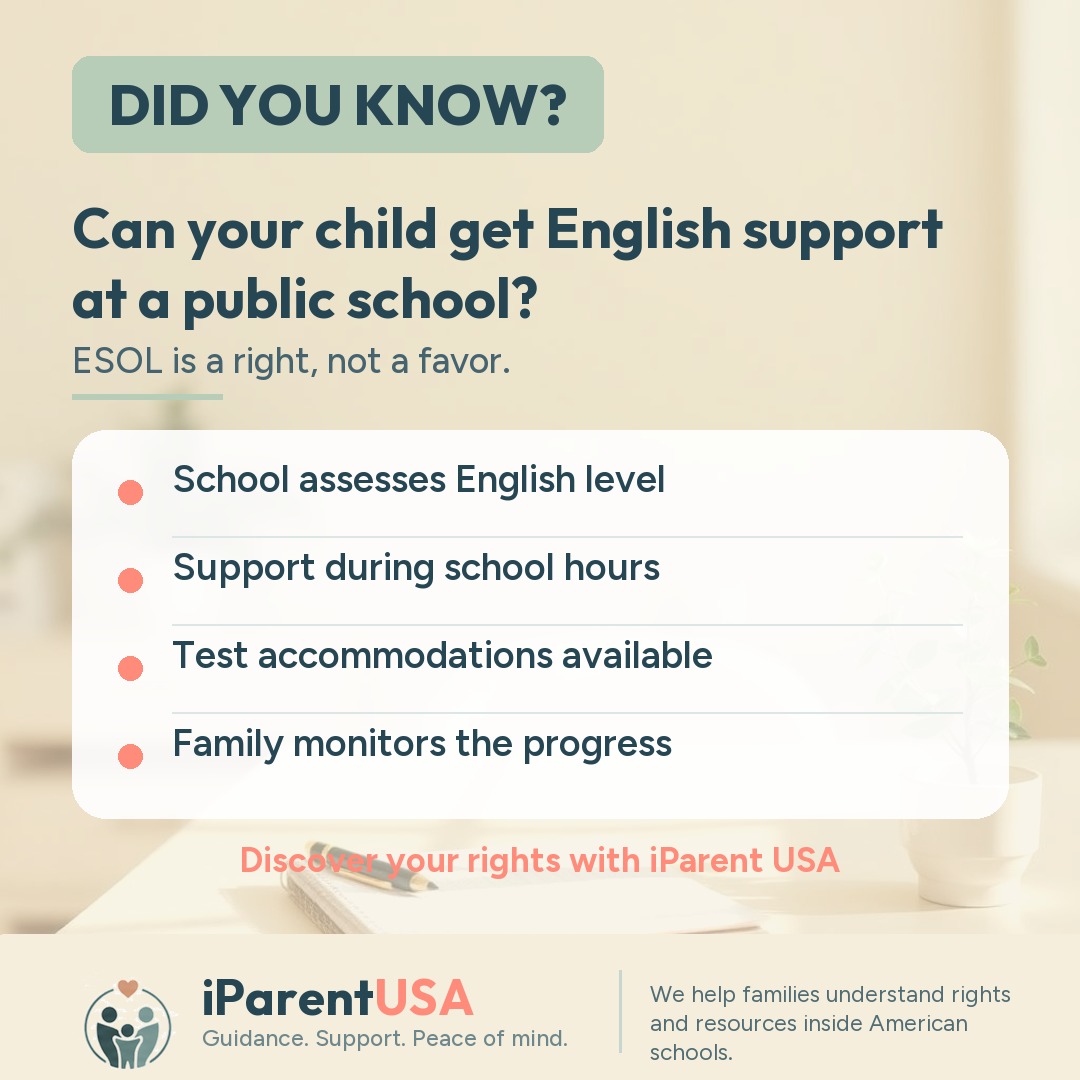
Children enrolled in U.S. public school who are still learning English are entitled, under federal law, to some form of language support. That support is usually delivered through programs called ESOL, ESL, or ELL, and the exact format varies by district.
What the ESOL program is
ESOL (English for Speakers of Other Languages) is the most common name for English support offered to students identified as language learners. The program may include dedicated English classes, in-class support, or a combination, depending on the child's age and proficiency level.
Identification usually starts with a home language survey filled out by the family at enrollment, followed by an English proficiency test administered by the school or district within the first few weeks.
It's a right, not a courtesy
Federal law guarantees access to English support for students who need it, regardless of a family's immigration status. If a school offers no visible support, it's worth asking the district's ESOL coordinator directly about available services.
Exiting the ESOL program also follows a formal process, generally based on new proficiency testing, rather than a decision the school makes alone without informing the family.
How families can support at home
Keeping up reading in any of the family's home languages supports a child's overall language development and does not slow down English acquisition, contrary to what some families fear.
Attending progress meetings and requesting an interpreter or translation when needed — a service many schools offer at no cost — helps the family track the student's progress closely.
Steps to secure English support
- Fill out the home language survey carefully at enrollment
- Ask about the English proficiency test and its results
- Request an interpreter or translation for school meetings when needed
- Ask the district's ESOL coordinator about available services
- Keep encouraging reading in the family's home language
Want to talk about your family's situation?
Book a free 15-minute consultation or get the free guide to your first 30 days in the United States.
Full guide on this topic: School system
Read next
- Can your child get school support without being gifted?Understand the difference between an IEP and a 504 Plan, two formal paths for school support in the US for kids with specific learning or health needs.
- Can the right house change your child's school?Learn how your home address determines your child's assigned public school in the U.S., and what to verify before renting or buying in a new neighborhood.
- Can your child take advanced classes without changing schools?Learn how gifted and talented programs work in American public schools and how to request an evaluation for your child.
- Do foreign documents need an apostille to work in the U.S.?Foreign documents often need an apostille to be recognized in the U.S. Learn when it's required and how the authentication process generally works.