
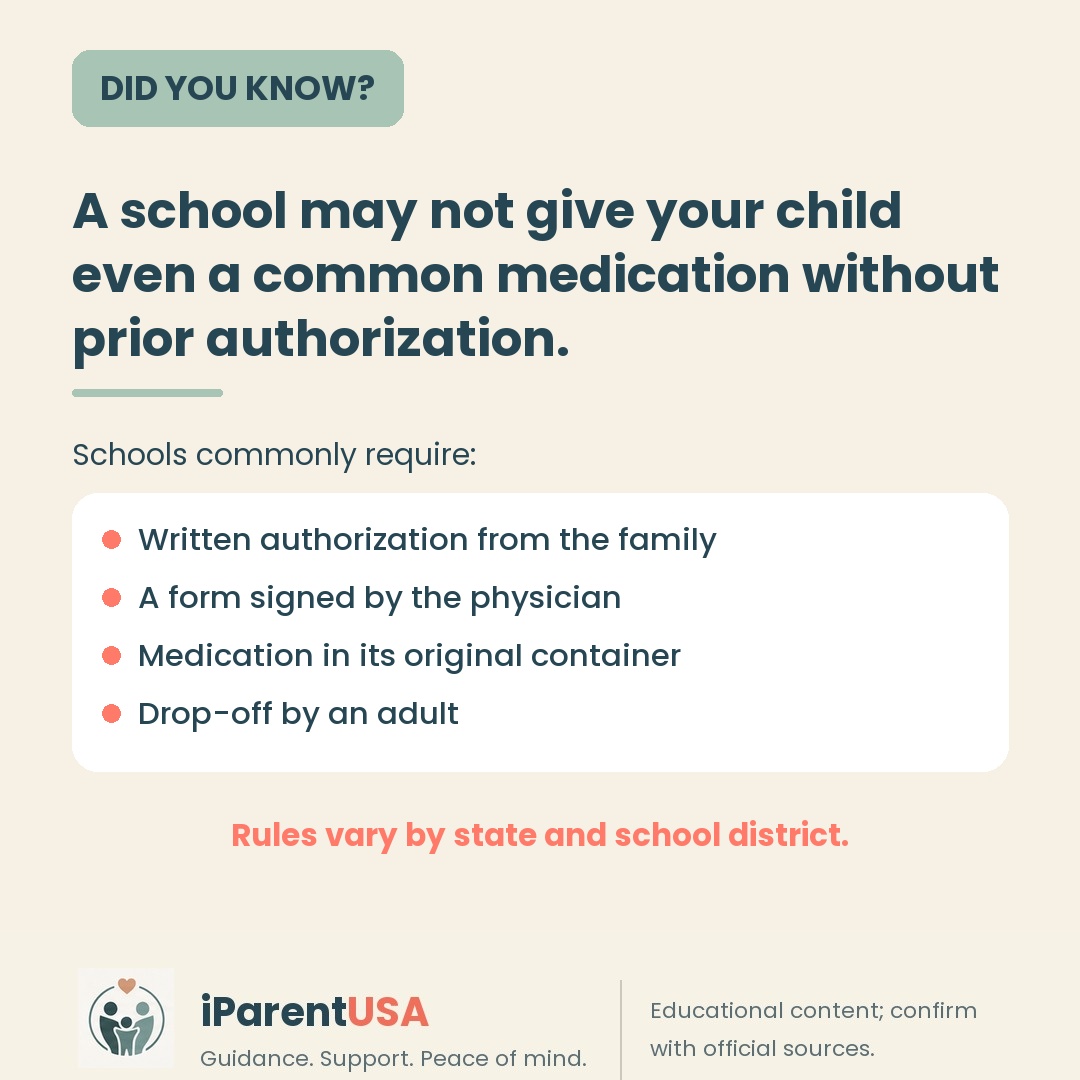
Many parents are surprised to learn that their child's school in the United States can't simply give a pain reliever or an antihistamine for a headache or allergy, even if it's an over-the-counter medication. The rules exist to protect students, but they require some planning ahead from families.
Why prior authorization is required
Public and private schools in the U.S. follow safety policies that generally prohibit staff from administering any medication — including over-the-counter drugs like acetaminophen or ibuprofen — without written authorization from parents and, in most cases, a doctor as well. This applies even to medications a family considers simple or routine.
The requirement exists to reduce risks of allergic reactions, drug interactions, or dosing errors, and to make clear who is responsible for the decision to medicate a child during school hours.
How the rules vary
Each state and each school district has its own medication administration policy, covering who can administer medication (school nurse, trained staff member), whether a child can carry and self-administer medication (common for asthma or severe allergies, with specific authorization), and which form needs to be completed.
Students with chronic conditions, such as diabetes, epilepsy, or severe allergies, often have individualized health care plans at school (health care plan or emergency action plan), developed together with the school nurse and, when applicable, integrated into an IEP or 504 plan.
What families need to prepare
Before the school year starts, or as soon as the need arises, parents generally need to complete a school-specific form, obtain a doctor's signature when required, and drop off the medication in its original packaging directly with the school office or nurse — the child typically cannot carry the medication in their backpack, except for authorized exceptions.
It's also worth asking in advance about the process for field trips and activities outside the school building, since medication administration rules may involve additional steps in those contexts.
What to arrange with the school about medication
- Ask the school office for the district's official medication authorization form.
- Confirm whether a doctor's signature is required in addition to parental authorization.
- Drop off the medication in its original packaging, labeled with the child's name.
- Ask about the procedure for field trips and extracurricular activities.
- For chronic conditions, talk with the school nurse about an individualized health care plan.
Want to talk about your family's situation?
Book a free 15-minute consultation or get the free guide to your first 30 days in the United States.
Full guide on this topic: School system
Read next
- Can your child get school support without being gifted?Understand the difference between an IEP and a 504 Plan, two formal paths for school support in the US for kids with specific learning or health needs.
- Your child's temporary caregiver may need written medical authorizationTraveling without your kids? Learn what a Medical Consent Form is, when providers may ask for one, and how to prepare it before leaving your child with another caregiver.
- Not every common Brazilian medication can freely enter the U.S.Before traveling, learn why some medications common in Brazil have a different status in the U.S. and how to check official rules before you fly.