
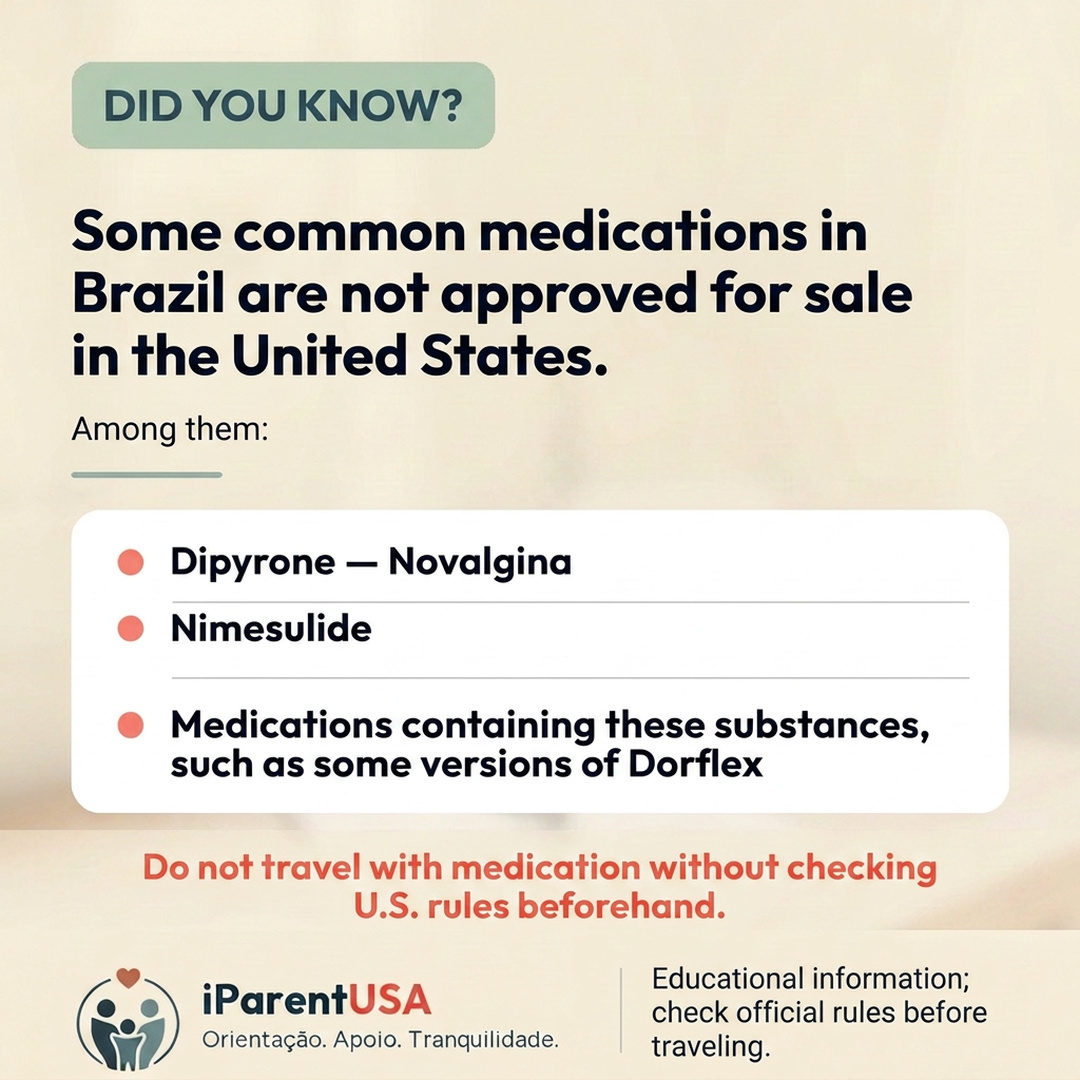
Many medications sold freely in Brazilian pharmacies have a different status in the United States: some require a prescription, others have a different formulation, and some have not been approved by the FDA for sale in the country. This doesn't necessarily mean they're banned from luggage, but the rules deserve attention before you travel.
Why the difference exists
The FDA (Food and Drug Administration) is responsible for approving medications for sale in the United States, and its review process is independent from the one used by Anvisa in Brazil. A medication can be widely sold in Brazil and still not have gone through U.S. approval — either because it was never submitted, or because its formulation differs from the U.S. equivalent.
This is common even with everyday medications, such as certain pain relievers, allergy medicines, and motion sickness remedies, which may have different names, dosages, or ingredient combinations than their U.S. counterparts.
What changes when traveling with medication
Generally, travelers can bring a reasonable amount of medication for personal use during their trip, but CBP (Customs and Border Protection) and FDA rules for personal importation of medications change frequently and depend on the type of substance. Controlled substances, in particular, have stricter rules and may require medical documentation.
A recommended practice is to always travel with medication in its original packaging, along with the prescription, and, when possible, a letter from the prescribing doctor explaining the condition being treated and the need for the medication.
What to do when the medication is needed in the U.S.
For ongoing treatments, the safer path is usually to consult a licensed physician in the United States, who can recommend a locally available equivalent or issue a new prescription valid in the country. Substituting medications on your own, without medical guidance, is not recommended.
It helps to bring a full list of medications used in Brazil to the appointment, including the active ingredient name (not just the brand name), dosage, and frequency, since this helps the U.S. doctor identify equivalents more accurately.
Before traveling with medication
- Check the FDA website for the status of each medication before you fly.
- Carry medications in their original packaging along with the corresponding prescription.
- For controlled substances, confirm specific CBP rules before traveling.
- Write down the active ingredient of each medication, not just the brand name used in Brazil.
- For ongoing use in the U.S., schedule an appointment with a physician licensed in the country.
Want to talk about your family's situation?
Book a free 15-minute consultation or get the free guide to your first 30 days in the United States.
Full guide on this topic: Healthcare
Read next
- Can you check a doctor's record before booking?Find out where to check complaints, reviews, and licenses for doctors in the U.S. before booking an appointment, and what this research can't replace.
- Does your child need the pediatrician even when not sick?Learn why kids in the US see the pediatrician even when healthy, the typical schedule of well-child visits, and how it connects to school enrollment.
- A school may not give even a common medication without prior authorizationLearn why U.S. schools require prior authorization to give even common medications, how rules vary by state, and what to prepare in advance.