
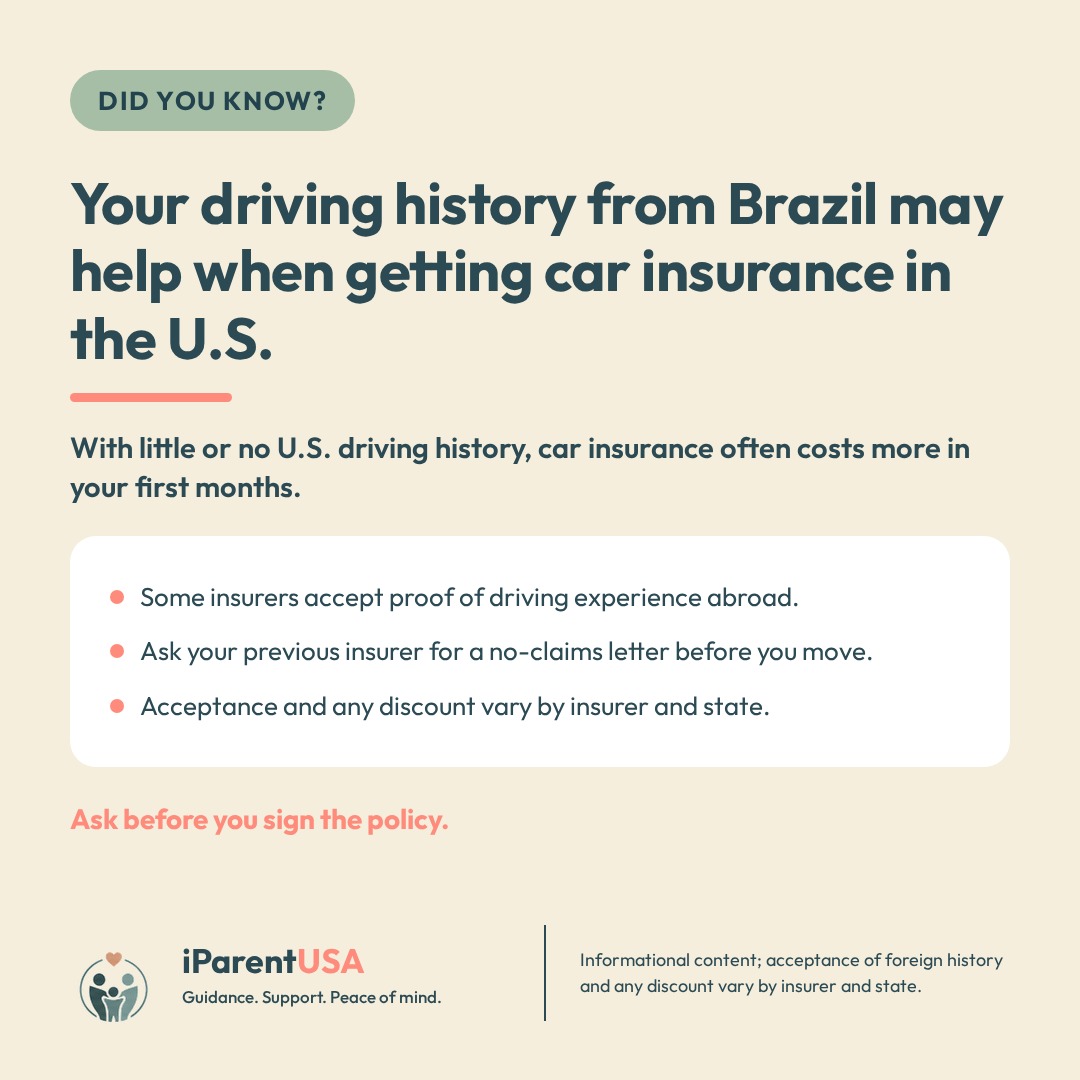
One of the first surprises for families arriving in the United States is the cost of car insurance. Even after many accident-free years of driving in Brazil, quotes can come back high simply because a U.S. insurer has no way to see that record. In some cases, it is worth asking whether the company will review documentation of your driving history abroad.
Why newcomers are quoted more
U.S. insurers price policies from data they can verify: years licensed, motor vehicle records, claims history and, in many states, credit-based insurance scores. Someone who arrived a few months ago usually has none of that, so the profile is treated as unknown — not necessarily as risky, but without a record that would justify a lower price.
That is why an experienced driver of 15 or 20 years can receive quotes similar to a brand-new driver. It reflects the information available, not a judgment about how you drive.
Which documents from abroad may help
Some insurers agree to review proof of driving experience earned outside the U.S. The documents most often mentioned are a no-claims letter or history statement from your previous insurer, proof of how long you have held a license, and prior policies showing coverage periods with no claims.
English translations generally make the review easier, and in more formal situations a certified translation may be requested. Confirm the accepted format before paying for translations.
To be clear: not every insurer accepts these documents, and even when one does, a discount is not guaranteed. Practice varies by company and by state.
How to raise it with an insurer or agent
Ask directly whether the company considers foreign driving experience or prior insurance history when quoting, and exactly what needs to be submitted. Independent agents who quote several carriers often know which ones tend to accept this kind of proof.
Compare at least three quotes and review common discounts too: paying in full, defensive driving courses, multiple vehicles, bundling auto with renters or home insurance, and telematics programs.
What changes over time
After several months or a year driving on a U.S. license with no violations and no claims, your profile starts to carry local history. Renewals and new quotes at that point usually reflect it.
Keep the documents from your home country anyway: they can help with a first policy, a switch between insurers, or when another family member applies for a U.S. license.
What to gather and ask before signing a policy
- Request a claims and history statement from your previous insurer before you move
- Keep prior policies and proof of how long you have been licensed
- Ask each insurer whether it accepts foreign driving history and in what format
- Compare at least three quotes and list the discounts each one offers
- Confirm your state's minimum coverage requirements before choosing a plan
- Review the policy at renewal, once you have U.S. driving history
Want to talk about your family's situation?
Book a free 15-minute consultation or get the free guide to your first 30 days in the United States.
Full guide on this topic: Insurance
Read next
- Does U.S. car insurance cover what you think?Learn the real difference between liability, collision and comprehensive car insurance in the U.S. so you're not surprised at claim time. A guide for newcomer families.
- Is your foreign driver's license valid in the U.S.?Whether a foreign driver's license is valid in the U.S. depends on the state. Learn when a local license is required and what documents are usually needed.
- Does your U.S. credit score start from zero?Learn how the U.S. credit score system works and why newcomers start with no history at all. Practical, responsible steps to begin building credit.
- Why checking your phone at a red light can result in a ticketIn some states, checking your phone at a red light can result in a ticket. Understand how distracted driving laws work and why they vary from state to state.