
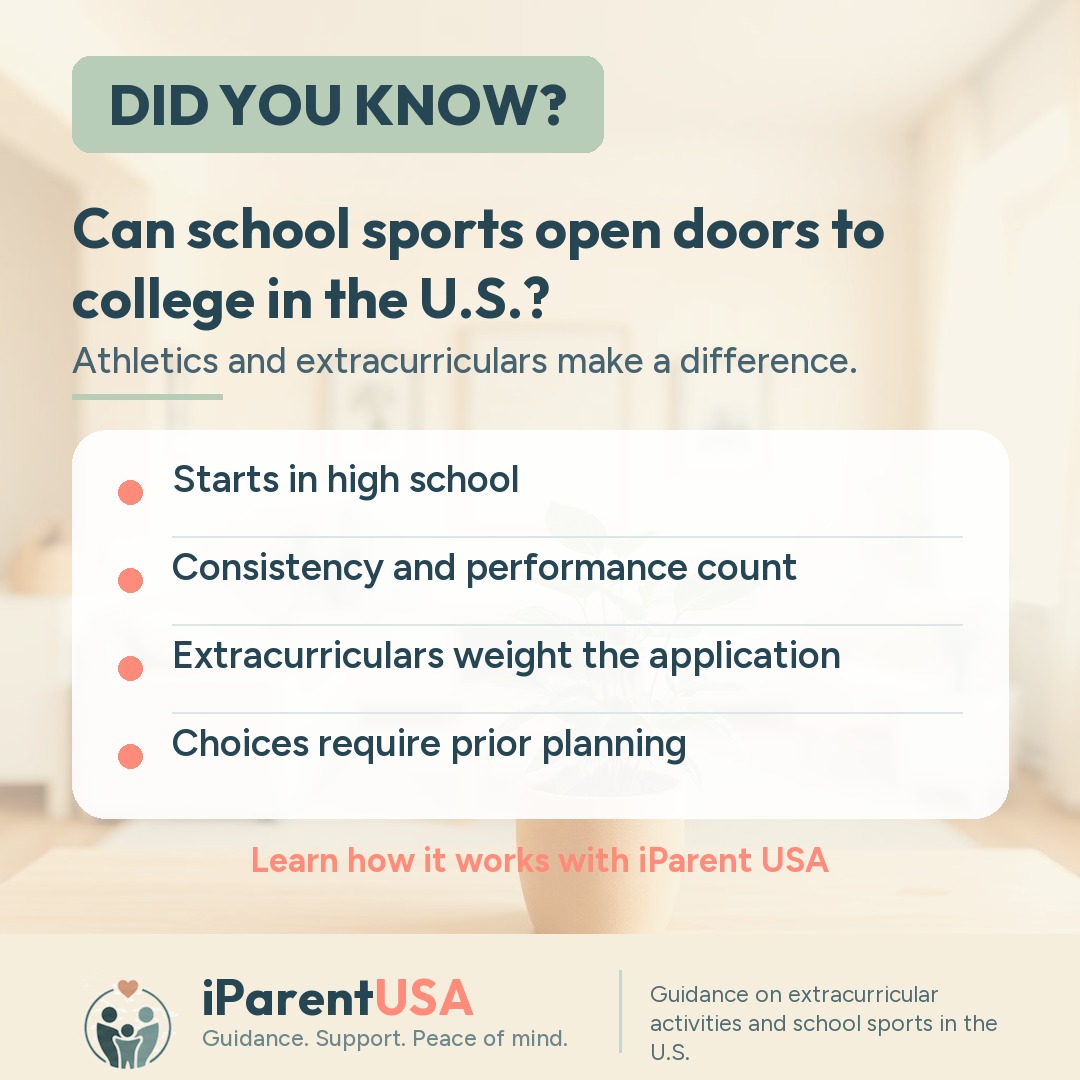
In the United States, joining a school team is more than a hobby: for many colleges, athletic history and extracurricular involvement are part of how a student is evaluated. Understanding how this works helps newly arrived families support their kids from high school onward.
Why extracurriculars matter in the application
American colleges, especially more selective ones, often look beyond grades for consistency, leadership and commitment over time. A student who plays on the school volleyball team for several years, for instance, shows discipline and teamwork, qualities valued in recommendation letters and admission essays.
This doesn't mean sports replace academics. They complement a student's profile and, in some cases, can lead to athletic scholarships, which have their own process and criteria, separate from merit-based academic scholarships.
How athletic scholarships generally work
Athletic scholarships are awarded by universities to students with notable sports performance, often tied to associations like the NCAA. The process usually involves registering with eligibility platforms, direct contact with college coaches, and, often, standing out at high school championships.
Criteria vary by sport, division and school, and not every high school offers the same visibility to recruiters. It's worth talking with the school counselor to understand a realistic path given the district and the specific sport your child plays.
Balancing sports, school and cultural adjustment
For international families, school sports are also an important way to integrate socially, helping kids make friends and pick up English naturally. Still, it helps to keep an eye on the practice and game schedule so it doesn't crowd out time needed for required coursework.
What to check about school sports
- Ask the school office which teams and leagues are available for your child's age.
- Talk with the counselor about how sports participation can factor into college applications.
- Research whether the sport of interest has a track record of athletic scholarships in your area.
- Keep an eye on the balance between practices, games and study time.
- Confirm health requirements, such as a mandatory physical before the season.
Want to talk about your family's situation?
Book a free 15-minute consultation or get the free guide to your first 30 days in the United States.
Full guide on this topic: School system
Read next
- Are AP and Honors the same thing?Understand the difference between AP and Honors courses in U.S. high schools and how that choice can influence a college application.
- SAT or ACT: which one fits your child?Learn the key differences between the SAT and ACT, how each exam is structured, and what to consider when helping your child choose the right test.
- Can middle-income families apply for college aid too?Learn why FAFSA isn't only for low-income households and how middle-income families in the US may still qualify for some form of college financial aid.
- Can school look after your child after class?See how after-school programs at US schools typically work, what they cost, and what to ask before enrolling your child.