
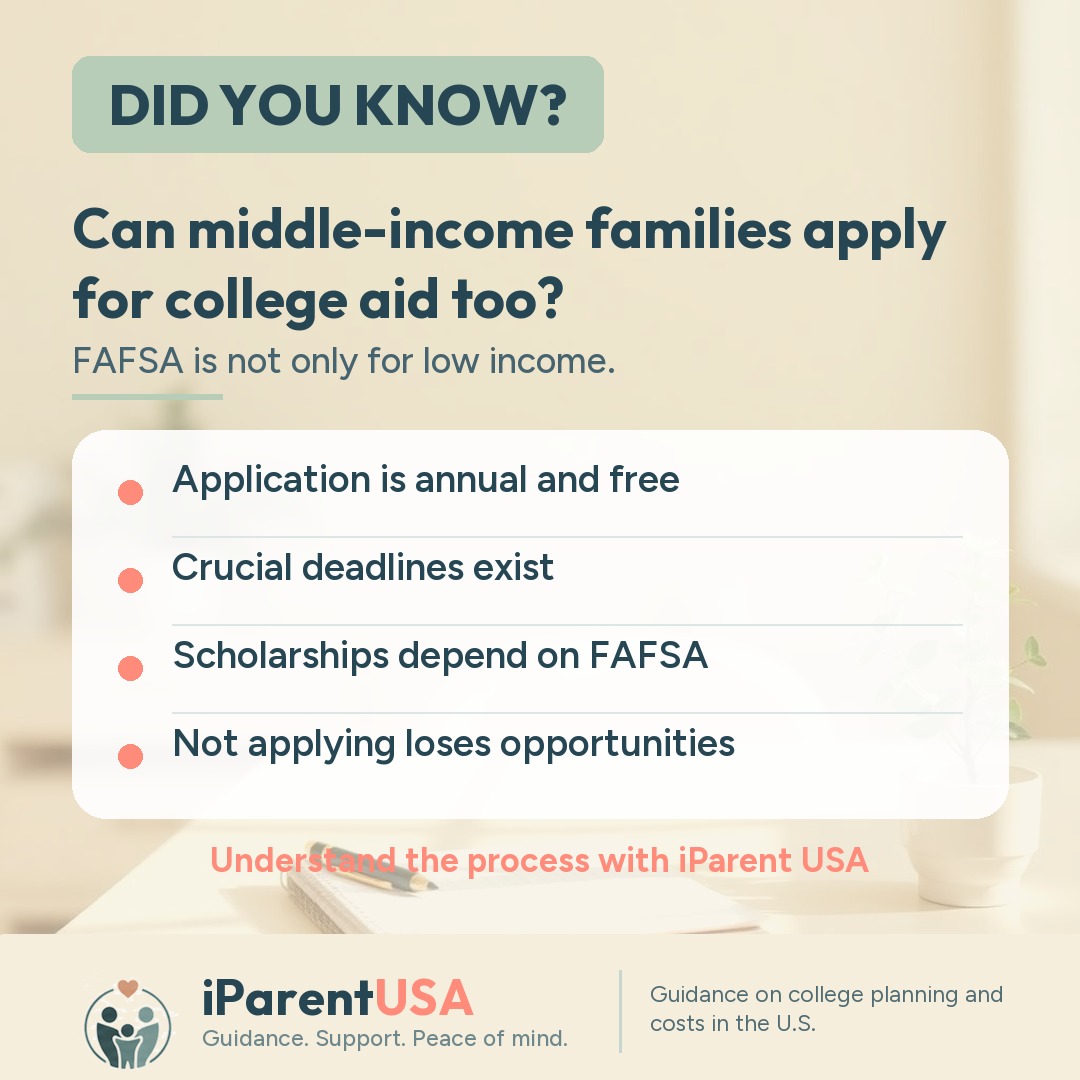
There's a common assumption that FAFSA, the college financial aid form in the United States, is only for low-income families. In practice, many middle-income families also qualify for some form of assistance, and it's usually worth filling out the form even without certainty about eligibility.
What FAFSA is and what it's for
FAFSA (Free Application for Federal Student Aid) is the form used by the federal government and most American colleges to calculate a student's financial aid need. It factors in household income, assets, family size and how many children are in college at the same time.
Based on that information, the system calculates an expected family contribution, which helps determine access to federal grants, lower-interest student loans, and, in many cases, institutional scholarships, which also use FAFSA as a reference point.
Why middle-income families shouldn't skip the form
Even families with what's considered a middle income can qualify for partial aid, especially if more than one child is in college at the same time or the local cost of living is high. On top of that, many colleges require a completed FAFSA as a prerequisite to award their own merit scholarships, even when there's no demonstrated financial need.
Skipping the form because you assume you 'won't qualify' can mean missing out on that kind of institutional scholarship, which sometimes doesn't depend only on income.
Deadlines and things to watch for
FAFSA has specific deadlines that vary by state and by college, and some types of aid are distributed on a first-come, first-served basis until the budget runs out. Since eligibility rules and amounts change every academic year, it's worth following updated official information and, if possible, talking to the financial aid office of the college of interest.
What to do before filling out FAFSA
- Gather household income documents, such as tax returns.
- Fill out FAFSA even without certainty about qualifying for aid.
- Check the specific deadline for each college of interest.
- Ask the financial aid office whether merit scholarships require a completed FAFSA.
- Redo the form every academic year, since family circumstances can change.
Want to talk about your family's situation?
Book a free 15-minute consultation or get the free guide to your first 30 days in the United States.
Full guide on this topic: College preparation
Read next
- Is there a tax-advantaged way to save for college?Understand how 529 college savings plans work in the U.S., including tax advantages and important considerations for international families.
- SAT or ACT: which one fits your child?Learn the key differences between the SAT and ACT, how each exam is structured, and what to consider when helping your child choose the right test.
- Should college prep start in 8th grade?See why beginning college planning as early as 8th grade can widen your child's options later, and how to build that timeline gradually.