
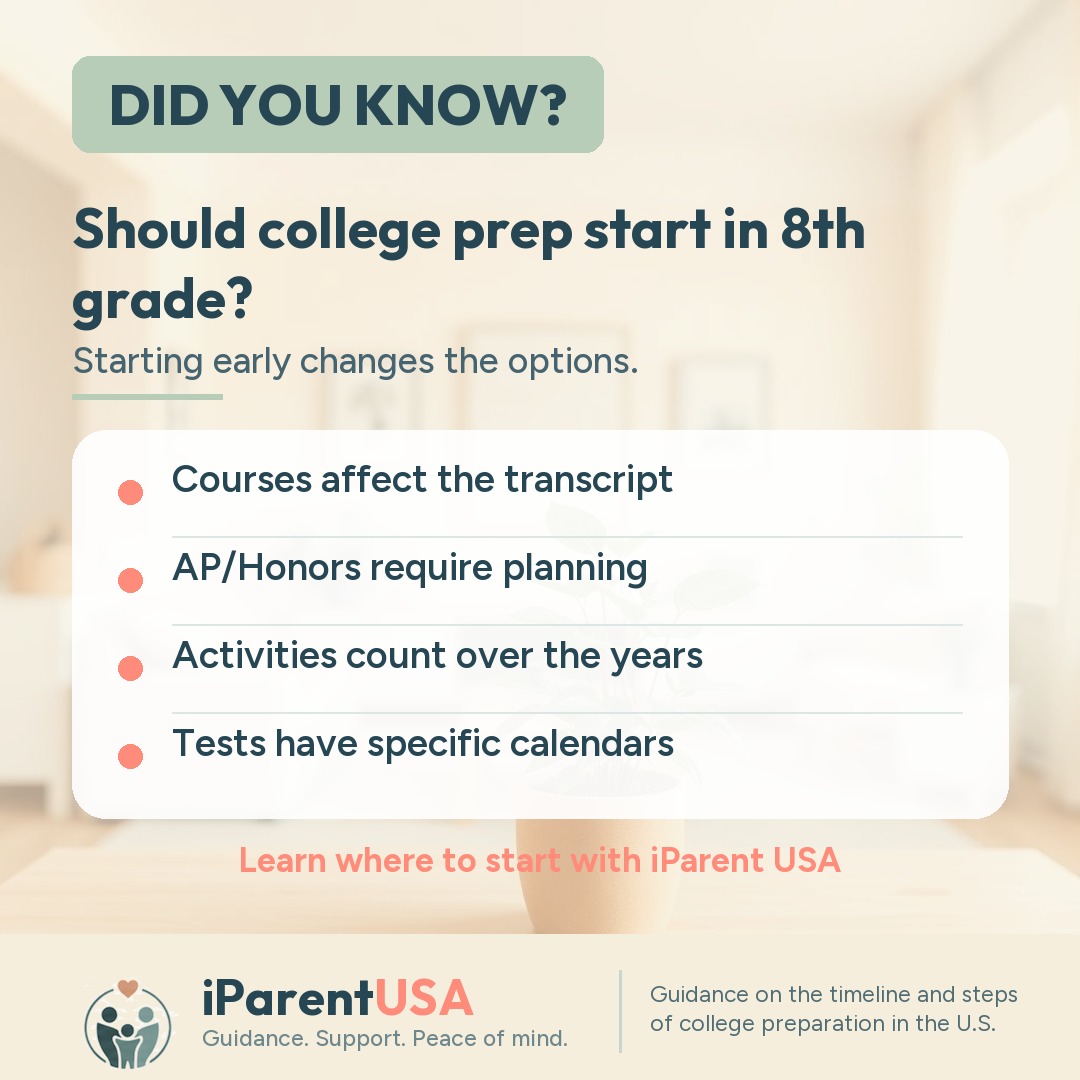
Many immigrant families discover too late that decisions made back in middle school, like which courses to take, can shape college options years down the road. Thinking about this in 8th grade doesn't mean pressuring the student — it means opening doors calmly and early.
Why 8th grade is a reasonable starting point
This is often when school districts determine which high school courses a student can enroll in, including advanced tracks like Honors classes or the early math credits that pave the way toward AP Calculus later on. Early choices about math sequencing and language courses can widen or narrow future options.
This doesn't mean a student who starts later is permanently at a disadvantage — just that early planning tends to allow more flexibility and less last-minute scrambling.
What this kind of planning typically includes
A realistic timeline usually involves talking with the school counselor about the course schedule, exploring extracurricular interests that could grow into longer-term commitments, and building an early sense of costs, including savings and possible financial aid sources. None of this needs to be locked in at this age.
For international families, it also helps to understand early how the U.S. school credit system works and how it compares to the student's prior school record, especially if there are plans to move states or return abroad.
Balancing planning with the student's age
Education counselors often recommend that 8th grade and early high school stay more exploratory than strategic: discovering interests, trying different subjects, adjusting to a new school system. More specific college admissions planning tends to pick up around 10th or 11th grade.
The goal isn't to rush childhood or the teen years, but to avoid a family discovering curriculum restrictions only once it's too late to adjust.
Practical steps to get started
- Talk with the school counselor about the course options available in the local high school.
- Ask how credit transfers work between school systems if the family has lived in another country or state.
- Encourage extracurricular activities that reflect genuine interests, not just what looks good on paper.
- Start researching, in general terms, how financial aid and college savings work in the U.S.
- Revisit the plan periodically as the student's interests mature.
Want to talk about your family's situation?
Book a free 15-minute consultation or get the free guide to your first 30 days in the United States.
Full guide on this topic: College preparation
Read next
- SAT or ACT: which one fits your child?Learn the key differences between the SAT and ACT, how each exam is structured, and what to consider when helping your child choose the right test.
- Can middle-income families apply for college aid too?Learn why FAFSA isn't only for low-income households and how middle-income families in the US may still qualify for some form of college financial aid.
- Is there a tax-advantaged way to save for college?Understand how 529 college savings plans work in the U.S., including tax advantages and important considerations for international families.