
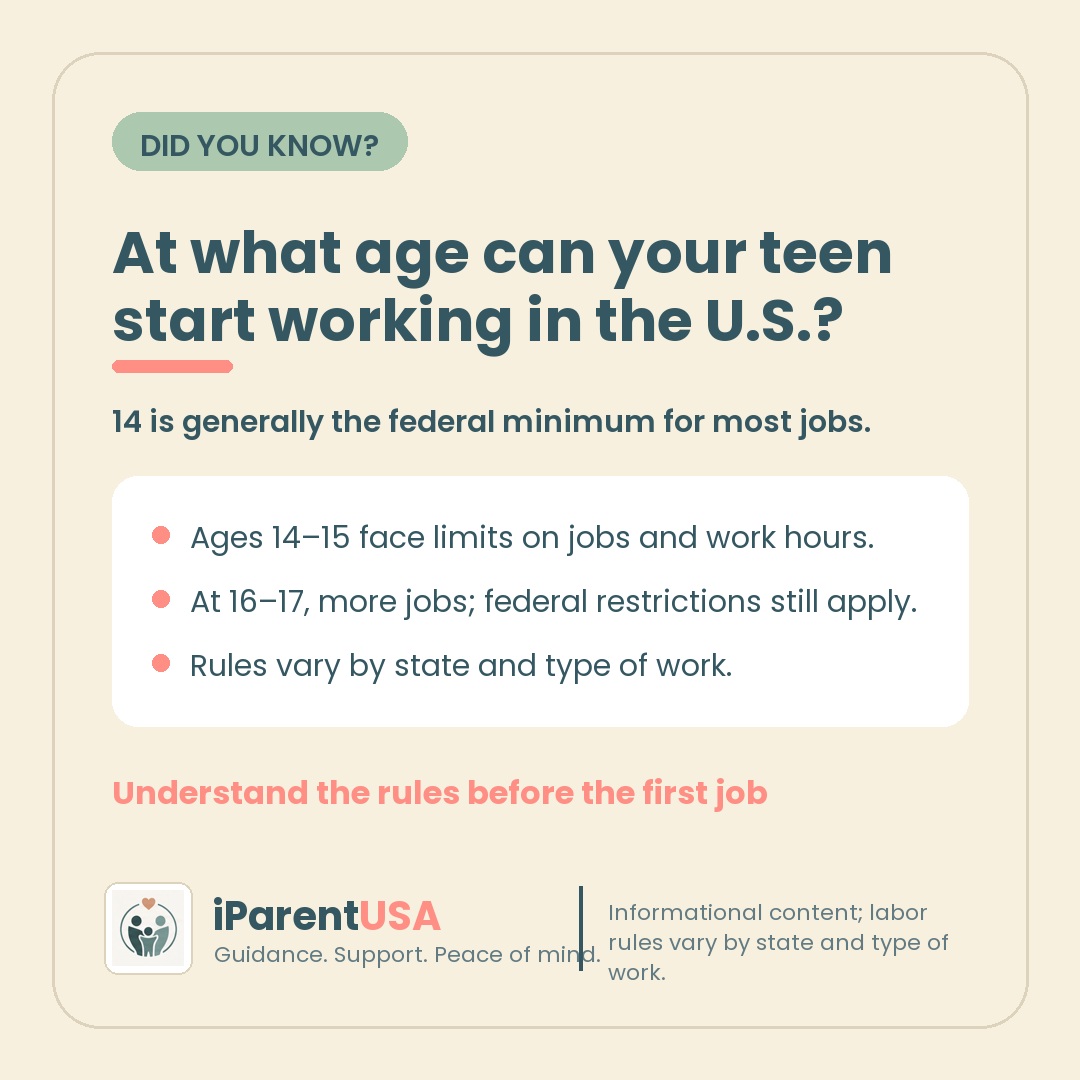
Many families wonder when a teenager can start working in the United States. Under federal law, 14 is generally the minimum age for most non-agricultural jobs — but there are exceptions, hour limits, and additional rules that vary by state and by type of work.
The federal rule by age group
In general, 14 is the federal minimum age for most non-agricultural employment. At ages 14–15, there are restrictions on which jobs can be performed and how many hours a teen may work, especially during school periods.
At ages 16–17, the range of permitted jobs is broader, but federal hazardous-occupation restrictions still apply. At 18, federal child-labor restrictions no longer apply.
State rules and exceptions
States may have their own rules, sometimes stricter than federal law, including hour limits, work permit requirements, and specific rules for the school year. When federal and state rules differ, the more protective one generally applies.
Not every job follows the same rule: agricultural work, working for the family business, and some occupations are treated differently. So it is not correct to assume every job is automatically allowed starting at 14.
What parents can do
Before the first job, check your state's rules, school-year hour limits, and whether a work permit issued by the school or state is required.
This content is informational only and does not replace legal or labor guidance. For specific situations, consult your state's labor department or a qualified professional.
Before the first job, check
- The minimum age for the type of work
- School-year hour limits
- Whether the state requires a work permit
- State rules beyond federal law
- Whether the job is considered hazardous for minors
Want to talk about your family's situation?
Book a free 15-minute consultation or get the free guide to your first 30 days in the United States.
Full guide on this topic: Everyday life
Read next
- Adding your child as an authorized user may help them begin building credit historyLearn how adding a child as an authorized user may help build credit history, depending on the issuer, credit bureau, and account management.
- A landlord may require a minimum income to rent a home in the U.S.Learn how U.S. landlords may review income, credit, background, and rental history before approving a rental application.
- Excessive school absences can become a serious issue in the U.S.Learn why frequent school absences may lead to school contact and formal steps, with rules that vary by state, district, and circumstances.
- Does your U.S. credit score start from zero?Learn how the U.S. credit score system works and why newcomers start with no history at all. Practical, responsible steps to begin building credit.