
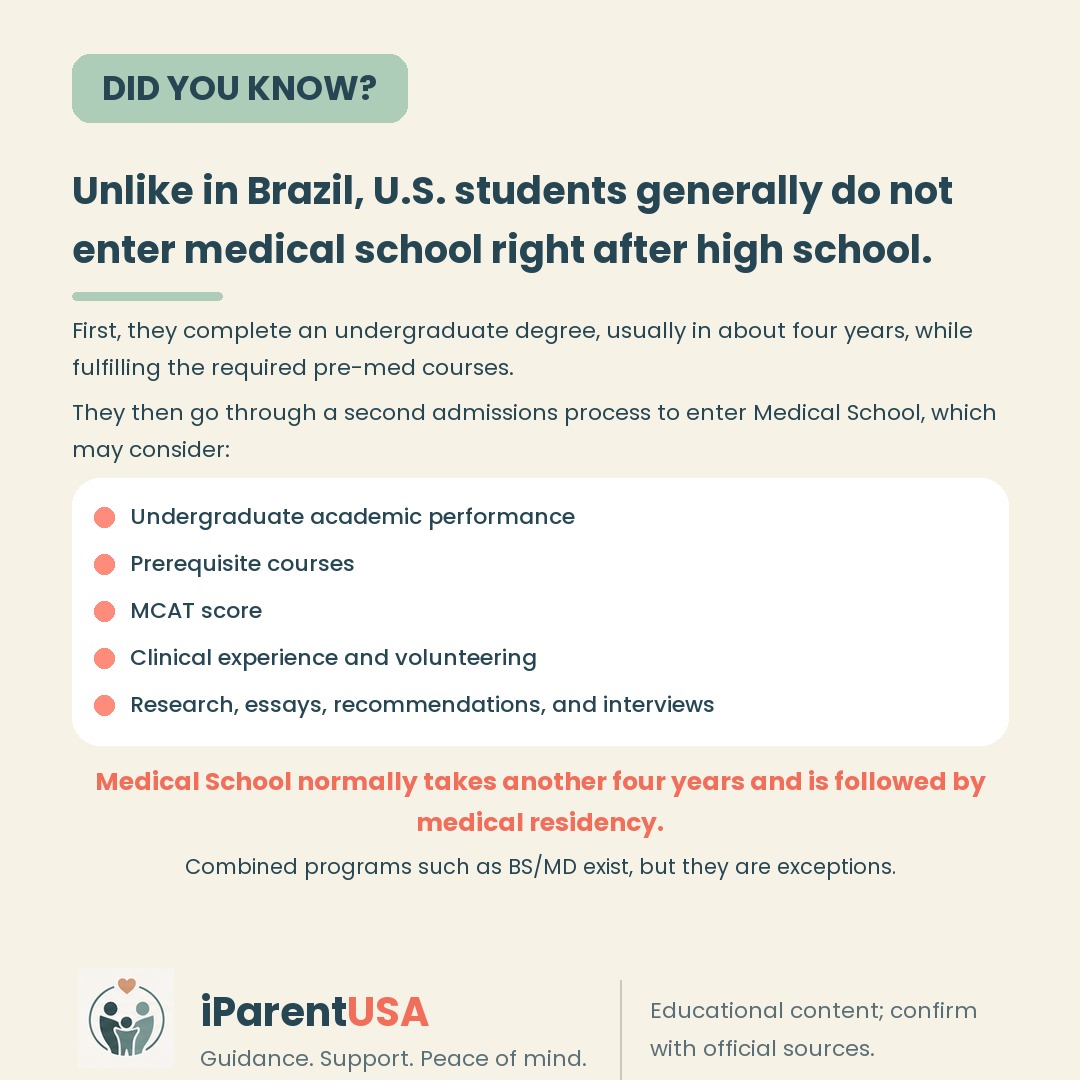
Families coming from countries where students can enter medical school directly after high school are often surprised by the U.S. system, which requires a completed undergraduate degree before even applying to medical school. Understanding this multi-stage structure helps families plan the path more realistically.
Undergraduate studies come first
In the U.S., students first complete a bachelor's degree, usually four years, in any field — it doesn't have to be biology or health sciences, although many students choose a related major. What matters is completing the so-called 'pre-med requirements': specific coursework in biology, chemistry, physics, and math required by medical schools, along with maintaining a strong GPA.
During undergrad, students are also expected to gain relevant hands-on experience, such as hospital volunteering, research, or working as a medical assistant, since medical schools weigh this experience alongside academic grades.
The medical school admissions process
Only after finishing (or nearly finishing) their bachelor's degree do students apply to medical school, a separate and highly competitive process involving the standardized MCAT exam, letters of recommendation, personal essays, and interviews. Medical school itself generally lasts four years.
After graduating from medical school, there is still medical residency, which can last three to seven years depending on the specialty, followed in some cases by a fellowship for subspecialization. The full path, from starting undergrad to becoming fully trained in a specialty, typically takes 11 to 15 years.
What this means for family planning
For immigrant families, it's worth considering the financial impact of this long path, since both undergrad and medical school carry high costs in the U.S., and financing and scholarship options vary depending on the student's immigration status. It also helps to talk with academic advisors as early as high school to build a course plan aligned with pre-med requirements.
Each university and each medical school sets its own admission criteria, deadlines, and required documents, so following the official pages of the institutions of interest directly is essential to avoid missing steps in the process.
When planning the path to medical school in the U.S.
- Research the pre-med requirements set by the medical schools you're interested in.
- Talk with an academic advisor as early as high school to align the course plan.
- Consider the total cost of undergrad plus medical school and the available scholarships.
- Seek hands-on experience, such as hospital volunteering or research, during undergrad.
- Check how immigration status may affect access to scholarships and student financing.
Want to talk about your family's situation?
Book a free 15-minute consultation or get the free guide to your first 30 days in the United States.
Full guide on this topic: College preparation
Read next
- SAT or ACT: which one fits your child?Learn the key differences between the SAT and ACT, how each exam is structured, and what to consider when helping your child choose the right test.
- Can middle-income families apply for college aid too?Learn why FAFSA isn't only for low-income households and how middle-income families in the US may still qualify for some form of college financial aid.
- Should college prep start in 8th grade?See why beginning college planning as early as 8th grade can widen your child's options later, and how to build that timeline gradually.