
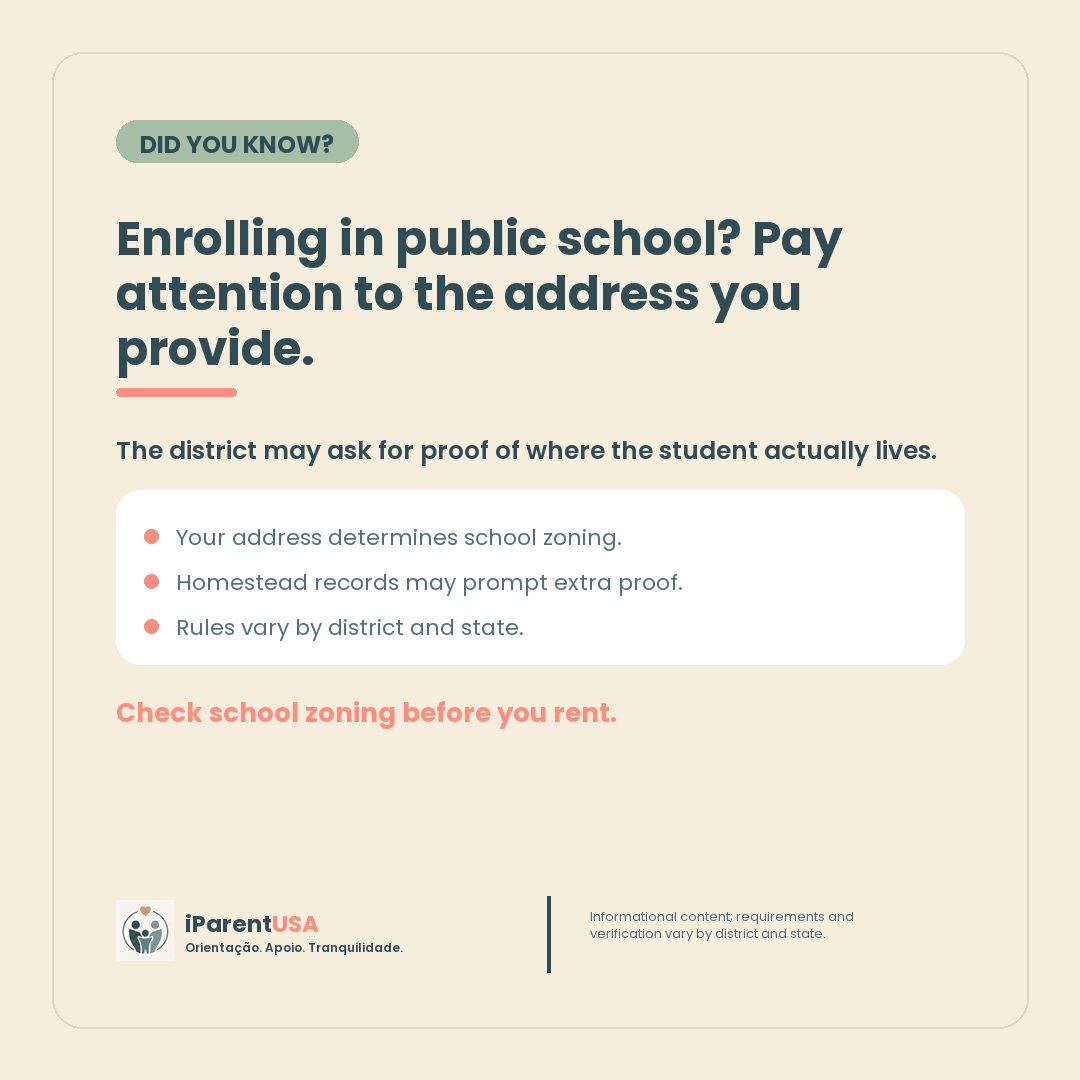
When enrolling a child in a U.S. public school, the district may verify that the student actually lives at the address provided. Families choosing where to rent should check both school zoning and the district's residency-document requirements before committing to a home.
Why the address matters
A child's assigned public school is often based on the address where the student resides. Districts may therefore request documents such as a lease, utility bills, identification, or other locally approved proof.
The exact list is not the same everywhere. Each district and state may use different requirements and verification practices, including for newly arrived families or those temporarily living with relatives or friends.
How Homestead Exemption may become relevant
A Homestead Exemption generally identifies a property as its owner's primary residence for certain tax benefits. That means that if the address given at enrollment is associated with another family's Homestead — someone else claims that property as their primary residence — the district may identify the discrepancy: the address the family provides is the same one that appears in the records as someone else's primary residence. Because of that discrepancy, the district may ask for additional documentation to confirm where the student actually lives.
This does not mean every school checks Homestead records or that a discrepancy automatically prevents enrollment. Practices vary, and other documents may help clarify who actually lives at the property.
What to check before renting for a particular school
Before signing a lease, confirm the address through the district's official zoning tool and review its current residency-proof list. Do not rely only on a property listing, a landlord's statement, or a third-party map.
For unusual arrangements such as subleasing, shared housing, or bills in someone else's name, ask the enrollment office which alternatives it accepts. A quick check can help the family plan the move with confidence.
What to verify before enrollment
- Confirm the assigned school through the district's official website
- Review the current list of accepted residency documents
- Check that the lease, bills, and identification are consistent
- Ask about alternatives for shared or temporary housing
- Keep current copies of every document submitted to the district
Want to talk about your family's situation?
Book a free 15-minute consultation or get the free guide to your first 30 days in the United States.
Full guide on this topic: School system
Read next
- Can the right house change your child's school?Learn how your home address determines your child's assigned public school in the U.S., and what to verify before renting or buying in a new neighborhood.
- Is public school in the U.S. really free?U.S. public school has no tuition, but recurring costs still show up during the year. Here's what to expect and how to budget for them.
- Charter School, Magnet School, and School Choice are not the same thingUnderstand what sets Charter Schools, Magnet Schools, and School Choice apart in the U.S., who can apply, how deadlines work, and what to check before deciding.
- Can renting in the U.S. depend on your credit score?Learn how credit scores affect rental approval in the United States and what newly arrived families without a credit history can do about it.