
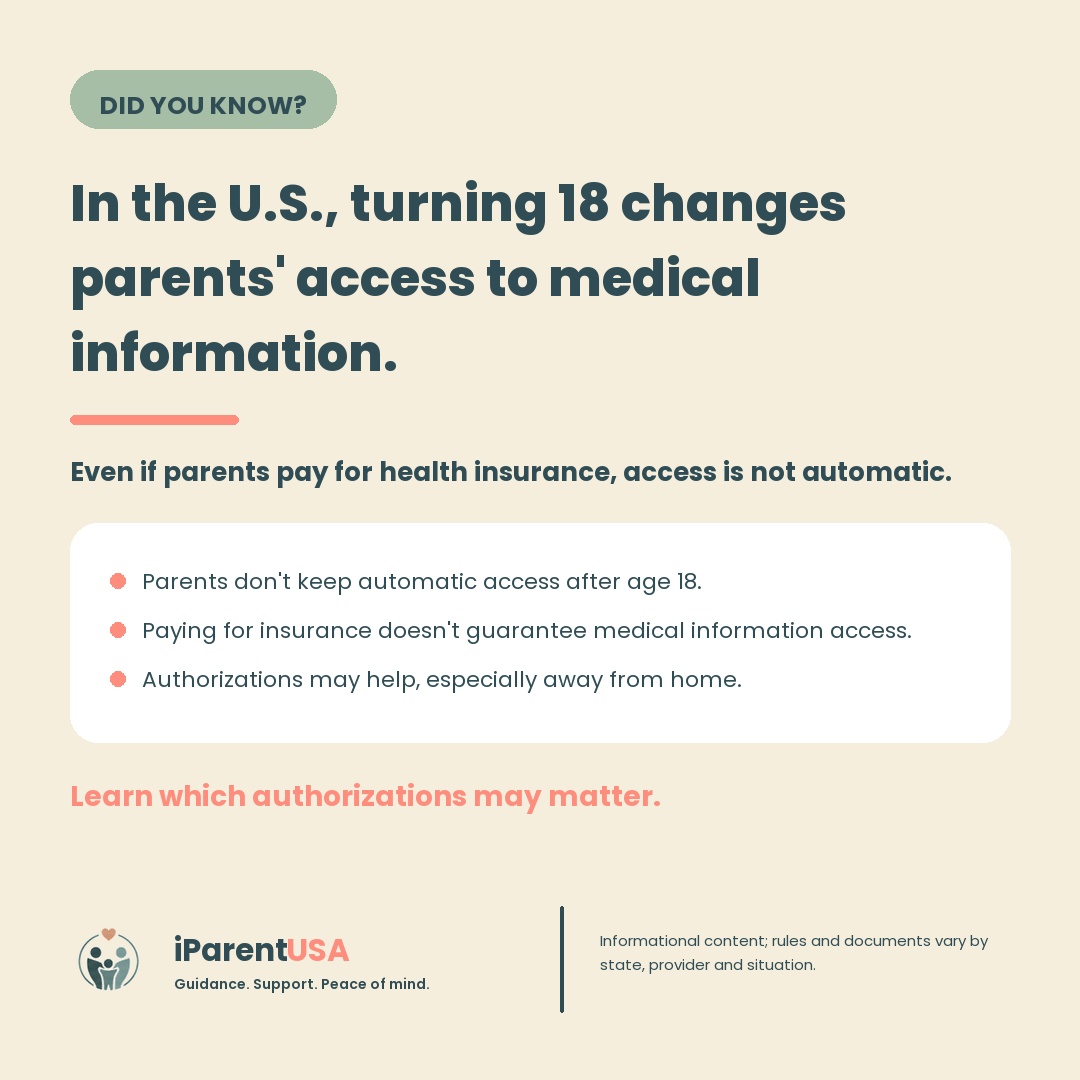
For many families, turning 18 feels like just another birthday. In the United States, however, that age often changes how hospitals, doctors, colleges, and insurers treat a child's health information: the student is generally treated as an adult for medical privacy purposes.
What changes at age 18
After a child becomes an adult, parents do not automatically keep access to medical records, test results, or conversations with healthcare providers simply because they are the parents. The young adult's own authorization often matters before certain information can be shared.
This can be true even when parents pay for health insurance or keep the student as a dependent on the policy. Paying for coverage does not, by itself, create a right to receive protected medical details.
Why it matters when a student lives away from home
If the young adult lives on campus, in another state, or far from family, a visit, hospitalization, or emergency can require quick communication. In a true emergency, necessary care usually comes first, but parents' access to details, documents, and non-urgent decisions may be limited.
That is why it helps to discuss the issue before the move: who may receive information, who may be contacted, and how the family wants to handle important medical situations.
Authorizations that may help
Medical information release forms, emergency contacts, and healthcare decision documents can help, but there is no single universal document that fits every case. Rules vary by state, institution, health plan, and circumstance.
A practical first step is to check the forms used by the doctor, hospital, or college, confirm local requirements, and consult an attorney in the relevant state when questions involve medical decision-making or legal authority.
What to discuss before age 18 or college
- Explain that medical privacy changes at age 18
- Check forms from the doctor, hospital, health plan, and college
- Decide who may receive information if needed
- Keep accessible digital copies of signed documents
- Review everything if the student studies or lives in another state
Want to talk about your family's situation?
Book a free 15-minute consultation or get the free guide to your first 30 days in the United States.
Full guide on this topic: Healthcare
Read next
- Your child's temporary caregiver may need written medical authorizationTraveling without your kids? Learn what a Medical Consent Form is, when providers may ask for one, and how to prepare it before leaving your child with another caregiver.
- Does your child need the pediatrician even when not sick?Learn why kids in the US see the pediatrician even when healthy, the typical schedule of well-child visits, and how it connects to school enrollment.
- Are urgent care and the ER the same thing?Learn the differences between urgent care and the emergency room in the U.S., when to use each, and how that choice affects your bill.
- Do you know what you pay before insurance starts covering?Understand what deductible and copay mean in U.S. health insurance plans and how these amounts affect what your family pays for each visit.