
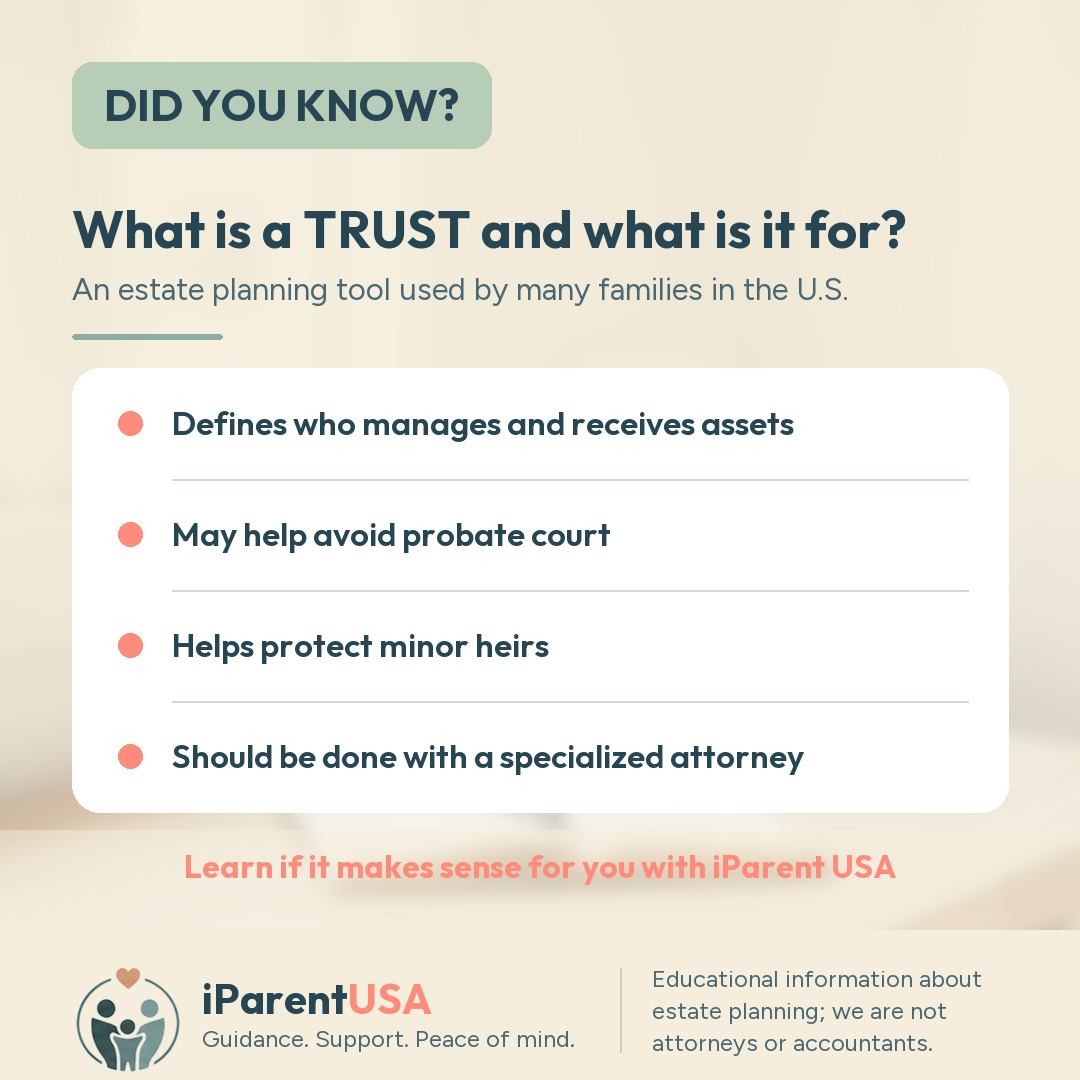
As families settle in the United States, many hear the word 'trust' come up in conversations about long-term financial planning. It's a real and widely used legal tool, but one that involves decisions about assets, inheritance, and taxes that call for professional guidance.
A simple definition
A trust is a legal arrangement in which a person (the 'grantor' or 'settlor') transfers ownership of assets — such as a home, investment accounts, or other property — to be managed by a 'trustee' for the benefit of one or more beneficiaries, following rules laid out in a document called a trust agreement.
There are different types, such as a revocable living trust, which the grantor can change during their lifetime, and irrevocable trusts, which are harder to modify once created. Each type carries different legal and tax implications.
Why families consider a trust
Commonly cited reasons include avoiding probate (the court process of transferring assets after death), maintaining more privacy around one's estate, and organizing how assets pass to heirs, especially when there are minor children or assets in more than one country.
For immigrant families, things can get more complex when assets exist both in the U.S. and in the home country, since each jurisdiction has its own inheritance and tax rules that need to be reconciled.
Why this isn't a do-it-yourself decision
Setting up a trust involves technical choices — the type of trust, who will serve as trustee, how assets will be transferred into it, and the tax consequences in the U.S. and possibly in the home country. Mistakes in structuring can create costs, delays, or outcomes different from what was intended.
This is a topic to discuss with an attorney licensed in estate planning and, when assets exist in more than one country, ideally also with an accountant or lawyer familiar with cross-border taxation.
Before considering a trust
- List the assets you hold in the U.S. and in your home country, with approximate values.
- Look for estate planning attorneys licensed in your state.
- Ask about the differences between a revocable and an irrevocable trust for your situation.
- Ask how a U.S. trust interacts with assets or inheritance abroad.
- Revisit the plan periodically, especially after moving states, marriage, or having children.
Want to talk about your family's situation?
Book a free 15-minute consultation or get the free guide to your first 30 days in the United States.
Full guide on this topic: Taxes
Read next
- Should college prep start in 8th grade?See why beginning college planning as early as 8th grade can widen your child's options later, and how to build that timeline gradually.
- Notarization and apostille are not the same thingLearn the real difference between notarization and apostille in the United States, when each is required, and how to authenticate documents for international use.
- Can your employer double your retirement savings?The 401(k) is one of the main workplace benefits in the U.S. and can include employer matching. Understand how it works before deciding to participate.